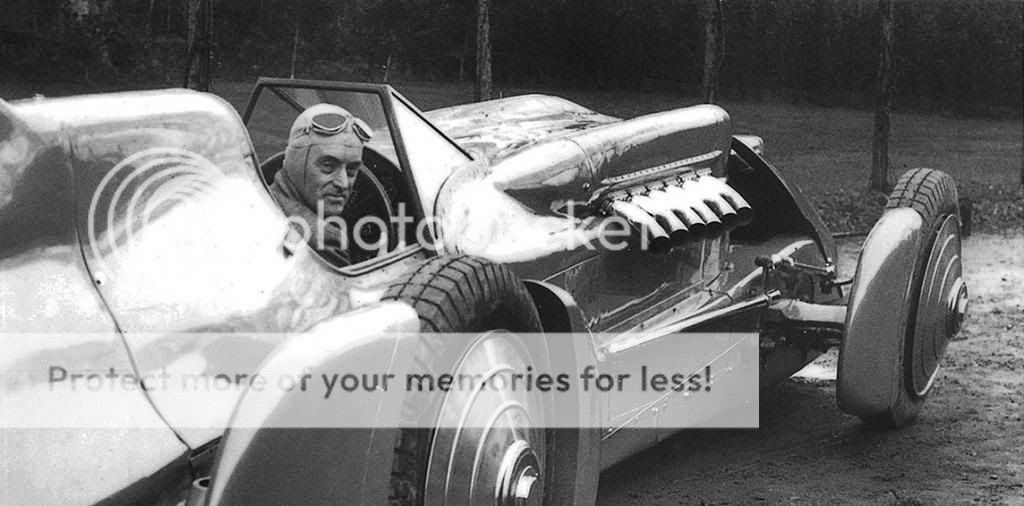
My first thoughts were Napier Railton, but it's not that. The gentleman is I believe Sir Malcolm Campbell, so it's a Bluebird, but which one I'm not sure without scouring the internet all night. But with a quick look i'd say maybe 1933?
The 1930s was the era of broken land, air and sea records. Sir Malcolm Campbell broke the land speed record in Bluebird at 272.46 mph in 1933. In 1937 George Eyston smashed this with 312.2 mph in Thunderbolt, powered by two Rolls-Royce 'R' engines. Sir Henry Segrave broke the world sea record at 119 mph in Miss England II, powered by 'R' engines. Moments later he was killed after colliding with a submerged tree stump.
How brave, or mad would you need to be to do 272 mph in that car? Even by todays modern standards and with all sorts of safety devices in a car that is a mega speed. Top Gears Richard Hammond crashed at that sort of speed a few years ago, which indicates how it's not even that safe today.
You can only admire the fearless approach to life, but I suspect that it was never that much of a surprise when one of these types of attempts went wrong.
I've only just noticed this. WOW, 272 MPH in an open top car, he REALLY had kahunas the size of melons. To make a car go at 272 MPH in the 1930's must have taken an engineering master mind, I most certainly feel like I'm not worthy ^^
Is it a V12 engine, maybe some sort of aircraft power plant?
Actually, rather than be lazy and ask I've just googled it:
Manufacturer
bodywork by Gurney Nutting
Engine 2,300 hp 36.7 litre supercharged Rolls-Royce R V12
Wheelbase 13ft 8in (4.17 m), Track front 5ft 3in (1.60 m), rear 5 feet (1.5 m)
Length 27 feet (8.2 m)
Curb weight 95 cwt (4.75tons)
Its a Rolls Royce engine, and it's never until you truly sit down and think about these things that reality comes home. That was a truly magnificent feat. He wasn't just racing he was risking his life. Actually really putting it on the line, and in those days doing what he did you could only do it for so long. I suspect that most of those racers and record breakers from that era lost their lives eventually. There were lots of unsung heros as well who on a weekly basis went out to race on their local circuits. I was not uncommon for them not to come home.
Incredible times, and these people pushed the boundaries.
On August 27, 1937, Captain George E. T. Eyston breaks his own automobile land speed record at the Bonneville Salt Flats in Utah, raising the mark to 345.49 mph
Eyston told the press at the time, he did not even bring his vehicle, the Thunderbolt, to full throttle to achieve the record-setting speed: "I had a very comfortable ride and not once did I feel there was any danger... I wanted to be certain I set a new record, but I also wanted to be sure that the car and I got through in good shape."
This site uses cookies to help personalise content, tailor your experience and to keep you logged in if you register.
By continuing to use this site, you are consenting to our use of cookies.