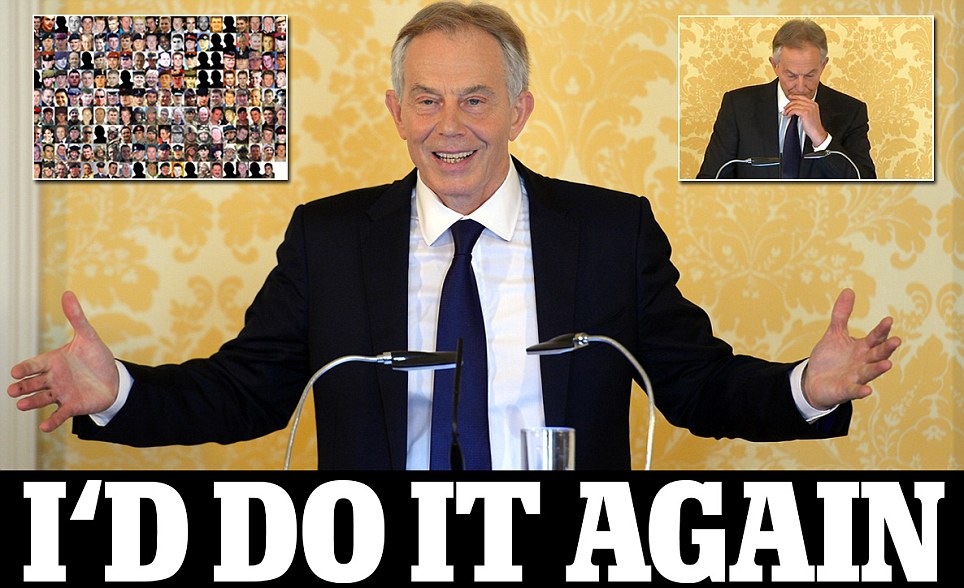

Just listened in full to his initial statement... Will take me a while to read the 2.6 million word report, but here are some of the quotes from it that I've lifted from the BBC News site
"Military action in Iraq might have been necessary at some point. But in March 2003 there was no imminent threat from Saddam Hussein, the strategy of containment could have been adapted and continued for some time, the majority of the Security Council supported continuing UN inspections and monitoring."
"We have, however, concluded that the circumstances in which it was decided that there was a legal basis for UK military action were far from satisfactory."
"We have concluded that the UK chose to join the invasion of Iraq before the peaceful options for disarmament had been exhausted. Military action at that time was not a last resort."
"The judgements about the severity of the threat posed by Iraq's weapons of mass destruction - WMD - were presented with a certainty that was not justified."
"It is now clear that policy on Iraq was made on the basis of flawed intelligence and assessments. They were not challenged, and they should have been."
"Ministers were aware of the inadequacy of US plans, and concerned about the inability to exert significant influence on US planning. Mr Blair eventually succeeded only in the narrow goal of securing President Bush's agreement that there should be UN authorisation of the post-conflict role."
"Mr Blair told the Inquiry that the difficulties encountered in Iraq after the invasion could not have been known in advance. We do not agree that hindsight is required. The risks of internal strife in Iraq, active Iranian pursuit of its interests, regional instability, and Al Qaeda activity in Iraq, were each explicitly identified before the invasion."
"Mr Blair had been warned, however, that military action would increase the threat from Al Qaeda to the UK and to UK interests. He had also been warned that an invasion might lead to Iraq's weapons and capabilities being transferred into the hands of terrorists."
"By 2007 militia dominance in Basra, which UK military commanders were unable to challenge, led to the UK exchanging detainee releases for an end to the targeting of its forces."
"It was humiliating that the UK reached a position in which an agreement with a militia group which had been actively targeting UK forces was considered the best option available. The UK military role in Iraq ended a very long way from success."
"Military action in Iraq might have been necessary at some point. But in March 2003 there was no imminent threat from Saddam Hussein, the strategy of containment could have been adapted and continued for some time, the majority of the Security Council supported continuing UN inspections and monitoring."
"We have, however, concluded that the circumstances in which it was decided that there was a legal basis for UK military action were far from satisfactory."
"We have concluded that the UK chose to join the invasion of Iraq before the peaceful options for disarmament had been exhausted. Military action at that time was not a last resort."
"The judgements about the severity of the threat posed by Iraq's weapons of mass destruction - WMD - were presented with a certainty that was not justified."
"It is now clear that policy on Iraq was made on the basis of flawed intelligence and assessments. They were not challenged, and they should have been."
"Ministers were aware of the inadequacy of US plans, and concerned about the inability to exert significant influence on US planning. Mr Blair eventually succeeded only in the narrow goal of securing President Bush's agreement that there should be UN authorisation of the post-conflict role."
"Mr Blair told the Inquiry that the difficulties encountered in Iraq after the invasion could not have been known in advance. We do not agree that hindsight is required. The risks of internal strife in Iraq, active Iranian pursuit of its interests, regional instability, and Al Qaeda activity in Iraq, were each explicitly identified before the invasion."
"Mr Blair had been warned, however, that military action would increase the threat from Al Qaeda to the UK and to UK interests. He had also been warned that an invasion might lead to Iraq's weapons and capabilities being transferred into the hands of terrorists."
"By 2007 militia dominance in Basra, which UK military commanders were unable to challenge, led to the UK exchanging detainee releases for an end to the targeting of its forces."
"It was humiliating that the UK reached a position in which an agreement with a militia group which had been actively targeting UK forces was considered the best option available. The UK military role in Iraq ended a very long way from success."